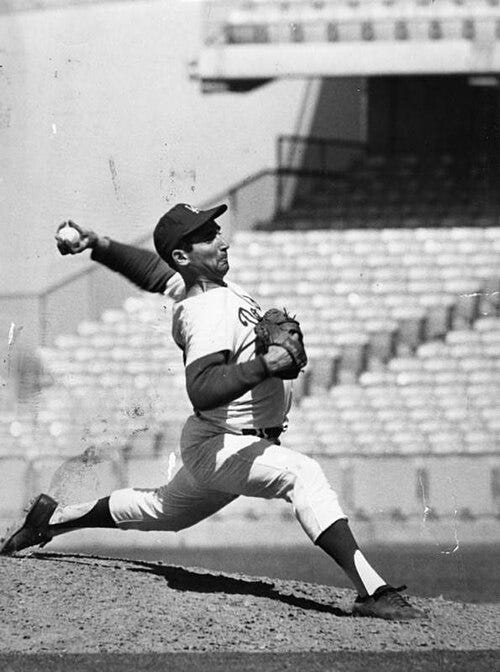
I recently heard a story about Sandy Koufax that I’d never heard before.
It immediately resonated with me — not just as a baseball story, but because of what it says about performance, perspective, and our tendency to sometimes make things harder than they need to be.
And with another Major League Baseball season winding down and attention beginning to turn toward October, this seemed like a fitting time to share it.
Sometimes the person closest to a problem isn’t the person best positioned to see it.
Sandy Koufax learned that lesson in the spring of 1961.
Today, Koufax is remembered as one of the greatest pitchers in baseball history. He won three Cy Young Awards, threw four no-hitters — including a perfect game — and helped the Los Angeles Dodgers win three World Series championships.
But that wasn’t the Sandy Koufax the baseball world knew during the first several years of his career.
Everyone could see the talent.
Koufax could throw a baseball extraordinarily hard. He had the kind of arm that made people believe greatness was inevitable.
There was just one problem.
He couldn’t always control where the ball was going.
During his first six seasons with the Dodgers, Koufax went 36–40 with a 4.10 ERA. In 691⅔ innings, he walked 405 batters.
The harder he tried to throw, the wilder he could become.
Then, during spring training in 1961, Dodgers catcher Norm Sherry offered Koufax a different perspective.
Stop Throwing So Hard
Koufax and Sherry were riding a bus from the Dodgers’ spring training home in Vero Beach to an exhibition game when Sherry suggested that Koufax ease up.
Sherry had noticed something.
When Koufax tried to generate even more velocity, he would tense up. Instead of making his already exceptional fastball better, the additional effort could cost him both movement and control.
Sherry suggested that Koufax stop trying to throw every pitch so hard, mix in more curveballs and changeups, and enjoy himself.
Then came the game.
The Dodgers were playing the Minnesota Twins in Orlando on March 23, 1961. Koufax walked the first three batters he faced, loading the bases without recording an out.
Sherry, who was catching him, again encouraged Koufax not to overthrow.
Koufax settled down.
He proceeded to pitch seven scoreless, no-hit innings.
Something had changed.
A few weeks later, Koufax described his improvement simply: he had shortened his windup, was throwing easier, and had more confidence.
He went on to win 18 games that season and lead the National League with 269 strikeouts.
It was the beginning of one of the most remarkable stretches of pitching in baseball history.
And I’ve been thinking about Norm Sherry’s role in that story.
Because Sherry wasn’t standing on the mound.
He was behind the plate.
A Different View of the Same Problem
Koufax knew he was struggling with control.
He knew he was walking too many hitters.
But he was experiencing the problem from the pitcher’s mound.
Sherry saw it from somewhere else.
From behind the plate, he could see what happened when Koufax tried to overpower hitters. He could see the tension. He could see the result.
Same pitcher.
Same baseball.
Same problem.
Different perspective.
I’ve experienced a version of that myself.
When I took responsibility for Parking and Transportation at Walt Disney World, I went through the same operational training our Cast Members did. One evening, while training in the Magic Kingdom parking operation, I noticed something as we loaded guests onto the parking trams.
Cast Members were instructing families to seat adults toward the outside of each row and children toward the inside.
There had been a very good reason for the practice. The parking trams originally didn’t have doors, and keeping children toward the inside reduced the risk of a child falling from the tram.
But doors had been added to every tram in 2008.
And we were still enforcing the same seating requirement.
What really brought it into focus for me was seeing it late at night.
It was 10 or 11 o’clock. Families had spent a full day in the Magic Kingdom and were ready to get back to their cars. They had made their way out of the park, waited for a ferryboat or monorail to take them across Seven Seas Lagoon to the Transportation and Ticket Center, and then waited again to board a parking tram.
Finally, they were seated.
Then we asked some of them to move.
Not surprisingly, guests would look at the closed tram door and ask some version of:
“Why? There’s a door.”
It was a reasonable question.
Our Cast Members bore the brunt of the frustration while enforcing the requirement. And we were creating one more unnecessary delay at the very end of a long day.
So I started asking the same question the guests were asking.
Why are we still doing this?
Eventually, we got on a conference call with our safety team. I explained what I had observed during training and said I was struggling to understand why we were still enforcing the requirement when every tram now had doors.
The answer was remarkably simple.
We had never gone back and changed the process after the doors were installed.
So I asked another question:
When did we put the doors on the trams?
2008.
We were having this conversation in 2016.
For eight years, we had continued enforcing a requirement designed to address a condition that no longer existed.
If that isn’t an organizational blind spot, I don’t know what is.
Once we questioned the requirement and reviewed it with the appropriate partners, we eliminated it.
The result?
Less friction for our guests.
Fewer unnecessary confrontations for our Cast Members.
And a more efficient operation because families could board, sit down, and we could load and go.
The operation changed. The process didn’t.
And for eight years, no one had challenged the disconnect.